

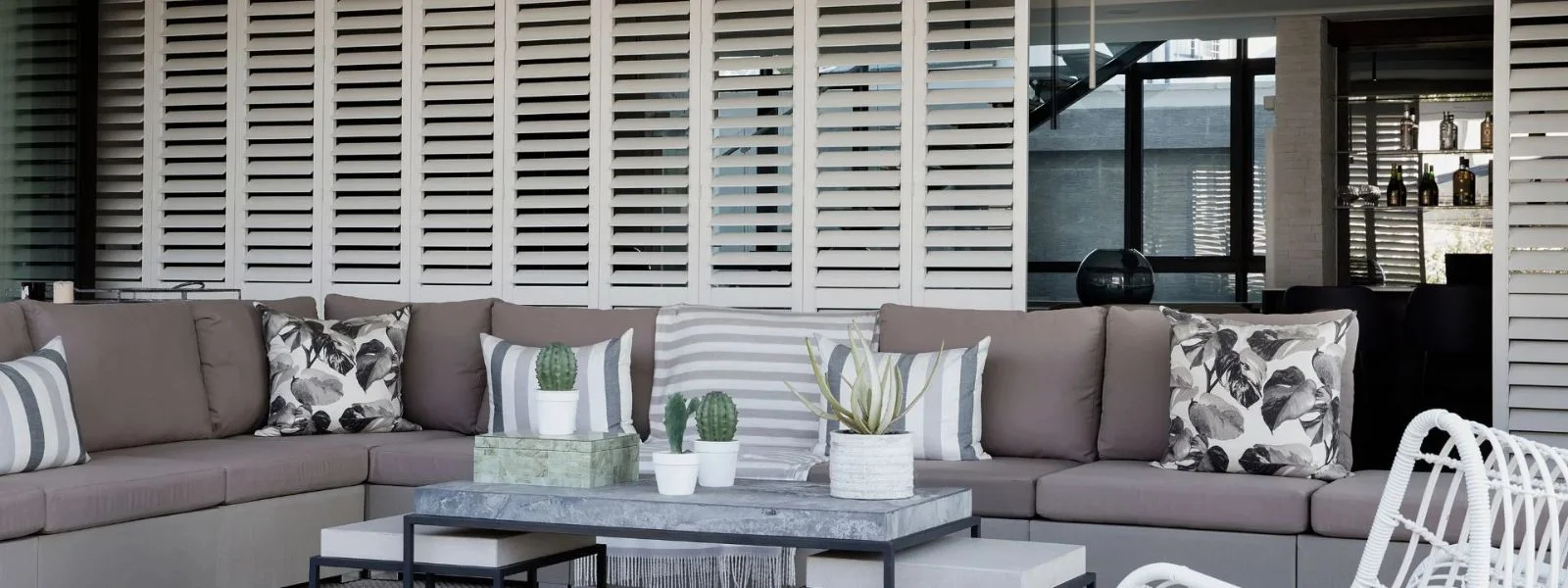
Quick answer: Louvre shutters remain one of the strongest window-covering trends of 2026, driven by wider blades, hidden tilt mechanisms, monochrome colours like charcoal and black, and coastal-grade aluminium that’s built for South Africa’s climate. Compared with curtains and blinds, louvre shutters last longer, add more resale value, offer better security, and give you precise control over light, privacy and airflow in one fixed, low-maintenance unit.
Below, we unpack why louvre shutters are trending, how they stack up against curtains and blinds, what makes them such a strong aesthetic choice, and the ten questions South African homeowners ask most often — answered in full.
What Are Louvre Shutters, Exactly?
Louvre shutters are rigid window and door panels made up of angled slats (louvres) that tilt open or closed inside a fixed frame. Unlike curtains or blinds, which hang in front of a window, shutters are mounted directly into the window or door opening, becoming a permanent part of the room’s architecture rather than a soft furnishing you add on top of it.
They’re typically made from one of three materials:
- Powder-coated aluminium – rust-proof, coastal-grade, and available with locking security options
- Solid hardwood (such as Kiri wood) – warm, natural grain, best suited to stable inland climates
- PVC or composite – budget-friendly and highly moisture-resistant for bathrooms and kitchens
The Trends Shaping Louvre Shutters in 2026
Window covering trends move slowly compared to fashion, but a few clear shifts are visible in 2026:
1. Wider louvre blades for a more open, architectural look
Blade widths of 89mm and above are now the standard for modern plantation-style shutters, replacing the narrower, more traditional slats of a decade ago. Wider blades let in more light when open and read as a bolder, more contemporary architectural feature rather than a purely functional cover.
2. Hidden tilt mechanisms
Homeowners are moving away from the visible centre tilt rod in favour of concealed “gear tilt” systems built into the frame. The result is a cleaner front-facing panel with no interruption across the louvres, and a tighter seal for better light and privacy control.
3. Darker, monochrome colour palettes
White is no longer the default. Charcoal, anthracite and black shutters are increasingly popular for the contrast they create against brick, render, timber cladding and painted walls, while soft neutrals and warm timber tones remain popular for more traditional interiors.
4. Full-height and slimline frame designs
Floor-to-ceiling shutter panels that span the entire window are being specified more often, particularly for tall windows, sliding doors and open-plan living areas, because they read as an architectural element rather than an add-on window treatment.
5. Material innovation for harsher climates
There’s a clear shift toward composite and hybrid aluminium-clad materials that resist moisture, UV and — in coastal areas — salt-air corrosion, without the maintenance that solid timber requires.
6. Shutters doing double duty as security
In South Africa specifically, aluminium louvre shutters with locking mechanisms are increasingly chosen to combine window dressing with a genuine security layer, often replacing burglar bars while still allowing full light, airflow and privacy control.
7. Motorisation and smart integration
Motorised louvre control is growing in popularity for large glazing, hard-to-reach windows, and smart-home setups, letting homeowners adjust light and privacy from an app or wall switch.
Louvre Shutters vs. Curtains vs. Blinds: The Real Benefits
Every window covering has a place, but louvre shutters consistently outperform curtains and blinds on the factors that matter most over the life of the product: durability, control, and long-term value.
| Factor | Louvre Shutters | Curtains | Blinds |
|---|---|---|---|
| Lifespan | 15–20+ years, especially in aluminium | Fabric typically fades or degrades within 3–7 years, faster on the coast | 10–20 years depending on material |
| Light & privacy control | Precise, adjustable louvre-by-louvre, even when “closed” for privacy | Full block or full open only — no in-between | Good control, but cords/mechanisms wear over time |
| Security | Can include lockable panels, replacing or supplementing burglar bars | None | None |
| Coastal/humid climate durability | Aluminium and PVC options are corrosion- and moisture-proof | Fabric absorbs moisture, mould and salt damage | Metal components can corrode; fabric can bleach |
| Maintenance | Wipe-clean, minimal upkeep | Regular washing, dust and mould-prone | Occasional dusting/wiping |
| Space usage | Fits flush in the window reveal | Needs wall space either side to stack back | Compact but can still overhang the frame |
| Home value | Adds architectural and resale value as a built-in feature | Does not add resale value | Does not typically add resale value |
| Upfront cost | Higher initial investment | Lower to moderate | Lowest |
| Insurance | Locking aluminium security shutters can qualify for short-term insurance discounts | No security benefit | No security benefit |
The honest trade-off: shutters cost more upfront than curtains or blinds. But because they’re a fixed, durable, architectural feature rather than a soft furnishing that needs replacing every few years, most South African homeowners find they work out cheaper per year over the life of the window — while also adding measurable value to the property itself.
A lot of homeowners don’t actually need to choose only one. Many South African homes use shutters in the rooms where permanence, security and durability matter most (living areas, street-facing windows, patios and coastal properties), and reserve blinds or curtains for rooms where fabric softness or budget flexibility is the priority.
The Aesthetic Case for Louvre Shutters
Beyond performance, louvre shutters are trending because of what they do for a room visually:
- They read as architecture, not decoration. Because shutters are built into the window frame, they look like part of the house rather than something hung in front of it — which is why they consistently work in both period homes and clean, modern interiors.
- They create texture and shadow play. The angled slats catch light differently throughout the day, adding depth to a wall of windows or sliding doors that flat glass alone can’t achieve.
- They pair well with the materials trending in 2026. Tactile, natural interior schemes — linen, boucle, timber, matt-painted walls — benefit from the crisp, clean lines of shutters as a visual counterpoint, rather than competing with another soft texture.
- They protect what’s inside the room. Closed or angled louvres reduce direct UV exposure on furniture, floors, artwork and fabrics, helping prevent the fading that curtains and blinds are less effective at controlling.
- They work indoors and outdoors. The same louvre design language now extends to patios, entertainment areas and exterior security shutters, creating a consistent look across a home rather than a mismatch of styles from room to room.
Top 10 Questions People Ask About Louvre Shutters (Answered)
1. What’s the difference between shutters and blinds?
Shutters are rigid, hinged panels permanently fitted into the window or door frame, with louvres that tilt for light and privacy control. Blinds are typically a single unit of slats or fabric that raises, lowers or stacks in front of the window rather than being built into it. Shutters generally cost more but last longer and add more resale value.
2. Are louvre shutters worth the extra cost compared to curtains or blinds?
For most homeowners, yes. While the upfront cost is higher, shutters typically last 15–20+ years versus 3–10 years for curtains or blinds, need far less maintenance, and add resale value as a permanent architectural feature — which brings the effective cost-per-year down significantly over time.
3. Do louvre shutters help with heat and energy efficiency?
Yes. Closed or angled louvres create an additional insulating barrier at the window, helping to keep interiors cooler in summer and reducing heat loss in winter, which can lower reliance on air-conditioning and heating.
4. Are aluminium shutters better than wooden shutters?
It depends on the room and climate. Aluminium is rust-proof, low-maintenance and best suited to bathrooms, kitchens, exterior areas and coastal properties. Solid hardwood offers a warmer, more natural aesthetic and suits stable, low-humidity interior rooms, but needs more upkeep, especially near the coast.
5. Can louvre shutters improve home security?
Yes. Lockable aluminium security shutters add a physical barrier over windows and doors while still allowing adjustable light, airflow and privacy — often reducing or replacing the need for separate burglar bars. Many are also built to a standard that can qualify for short-term insurance discounts; it’s worth confirming this with your insurer.
6. Do shutters work in bathrooms and other high-moisture rooms?
Yes, provided you choose the right material. Aluminium, PVC and specially treated waterproof timber shutters are designed to handle humidity, condensation and daily moisture exposure without warping, swelling or growing mould — unlike most curtain fabrics.
7. How much maintenance do louvre shutters need?
Very little. Routine dusting and an occasional wipe with a damp cloth is usually enough. In coastal areas, more frequent cleaning (roughly every one to four weeks) helps remove salt residue from aluminium finishes; inland, every three to six months is typically sufficient.
8. Will louvre shutters suit a modern home, or only traditional-style houses?
Both. While plantation shutters originated in traditional and colonial architecture, 2026’s wider blades, hidden tilt mechanisms, and dark monochrome colours have made shutters a strong fit for Scandinavian, minimalist and industrial-style interiors too — not just period homes.
9. Do louvre shutters add value to a home?
Yes. Because shutters are custom-fitted, built-in features rather than removable soft furnishings, they’re widely regarded — including by many real estate professionals — as one of the few window treatments that can positively influence a home’s resale value.
10. Can shutters be custom-made for oddly shaped or angled windows?
Yes. Reputable manufacturers custom-measure and manufacture shutters for arched, angled, bay and irregularly shaped windows and doors, which is something off-the-shelf curtains and blinds generally can’t accommodate well.
Choosing the Right Shutters for Your Home
The best choice ultimately comes down to three questions: how much privacy and security you need, what your local climate demands (especially near the coast), and which rooms genuinely benefit from a permanent, architectural window treatment versus a softer, more flexible one.
If you’re weighing up shutters against curtains or blinds for your own home or business in South Africa, American Security has been custom-designing, manufacturing and installing louvre shutters, blinds and screens across the country since 1985, using sustainably sourced timber and durable aluminium built for local conditions.
If security is the priority alongside style, Security of Things specialises in lockable aluminium security shutters — including the AS-SENTINEL™, AS-ELITE™ and AS-RADIANT™ ranges — engineered to combine protection with the same clean, adjustable louvre design covered in this guide.
We offer free, obligation-free site consultations and quotes to help you match the right material, co

